
Where Your Capital Is Working — and Where It Isn't
Every options seller has a finite amount of capital and a finite amount of attention. The hardest question isn't which trade to put on next. It's where should the next dollar go — and where should you stop deploying capital entirely?
That question has a real answer in your own history. Every ticker you've sold options on has a yield (return on the capital it ties up) and a premium total (how much you've actually collected). The combination tells you what's actually working and what just feels like it is.
Until this week, that answer was buried across rows of tickers and four strategy cards. As of the redesign, it's the first thing you see on Income and Stats.
The map
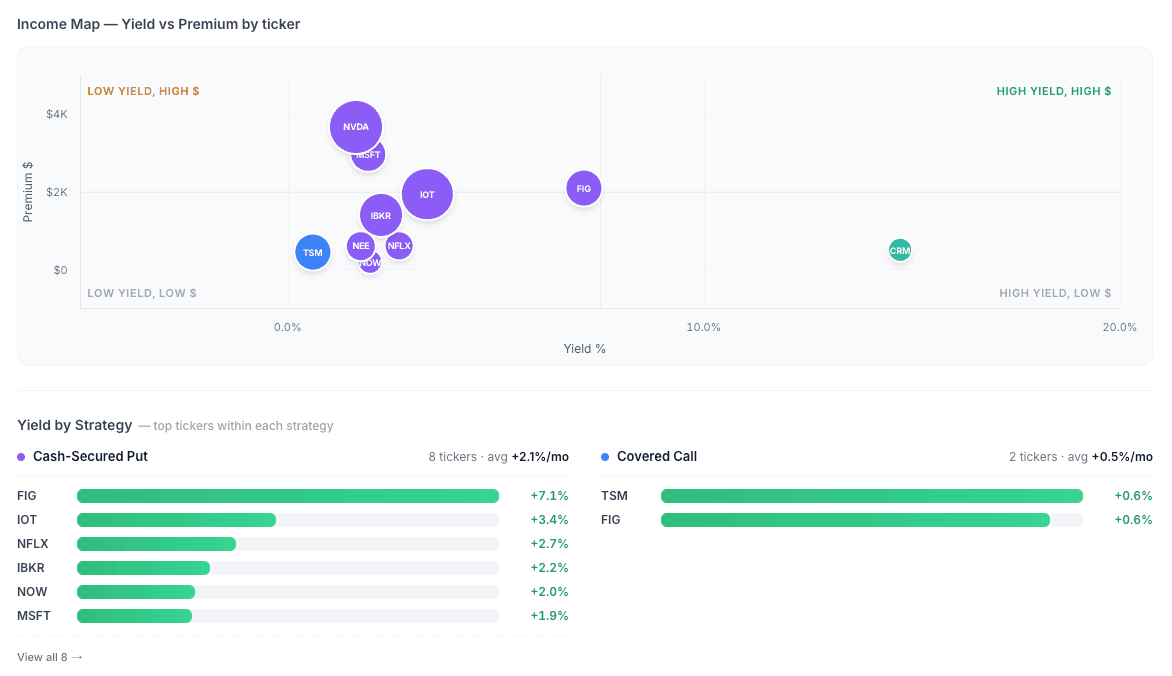
The Income Map plots every ticker you've sold options on as a bubble. Yield % on the x-axis — your return on the capital tied up in that position. Premium $ on the y-axis — how much absolute premium you've collected. Color follows the strategy family.
Four quadrants, four different decisions:
Real capital deployed for unimpressive returns. Resize, or move the capital somewhere better.
Strong yield and meaningful volume. This is your edge — lean in.
Low yield, low volume. Not worth fixing in isolation, but worth not adding to.
The yield is there, the volume isn't. You may have something working you haven't leaned into.
The chart was already there. The redesign gave it room to breathe and made it the first thing you see on Income.
Zooming out: which strategy deserves more capital?
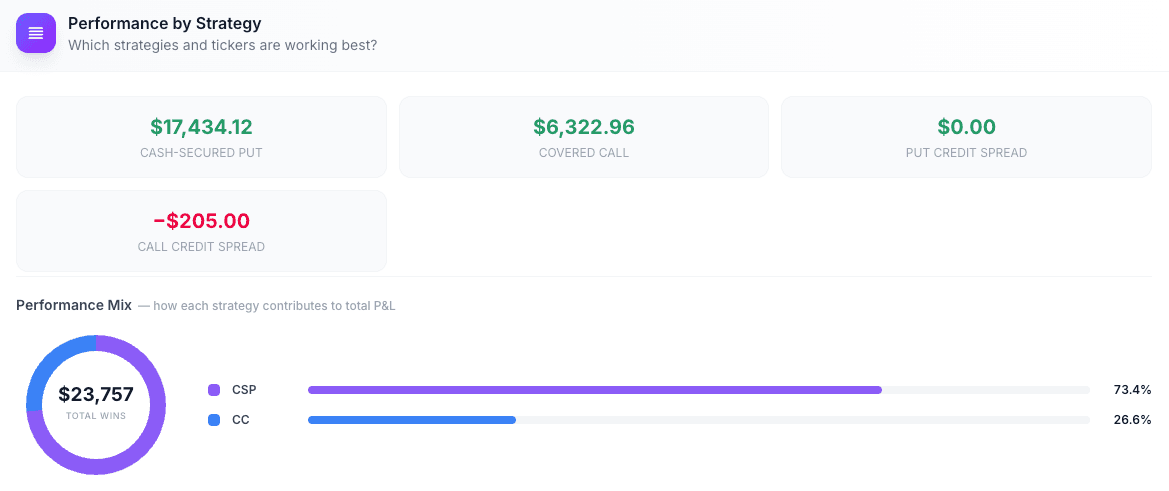
The map answers the question at the ticker level. The Stats page answers it at the strategy family level.
The Performance Mix view shows each strategy family — cash-secured puts, covered calls, credit spreads — sized by its contribution to total P&L. Above it, four tiles call out each family's net contribution. Strategies that net negative show in red and aren't compressed into a positive slice; the visualization stays honest.
The question to ask while looking at it: "Which strategy family is doing the work here, and is my time allocation matching that?" If 73% of your P&L comes from CSPs but you spend most of your week tinkering with credit spreads, that's a signal — either to shift time, or to figure out why the spreads aren't paying off the attention.
Drilling in: which tickers within a strategy?
Once the map and the Performance Mix point you at a strategy family worth more capital, the Yield by Strategy panels under the map show the top tickers within each family — average monthly yield, side by side. CSPs on the left, covered calls on the right, with each panel's average yield in its header.
Filter the page to a single strategy and the panels collapse into a full-width detail leaderboard ranked by yield — more tickers, more columns, more rows. The page reshapes itself for the question you're asking.
A note about yields you can't believe
If a strategy has only two trades and one was a single credit spread that yielded 480%, that's not a meaningful number — it's a sample-size artifact, and it would distort any allocation decision you made off it. Those are now hidden as outliers in the panel view. Look for "1 outlier hidden" with a click to expand. Anything with three or more trades is shown unconditionally, no matter the yield. The rule is "small N and large yield," not "small N alone" — a CSP with two trades at 4% yield is still informative.
What got removed
The P&L by Ticker bar chart on Stats. Redundant once the Performance Mix bars showed each strategy's contribution at the family level — and the cards above already called out per-strategy dollar totals.
The "X trades · Y% WR" third line on the strategy cards. Redundant with what the panels below already show. Removed it; the cards have their breath back.
What it doesn't do
It doesn't tell you which trade to put on next. It doesn't predict next quarter's outcomes. It doesn't recommend tickers.
What it tells you is where your capital has actually been working, in your own data. The allocation decision is still yours. The data finally isn't in the way.
Try it
Go to /income and look at the Income Map first. Which of your tickers are in the top-right quadrant? Are any in the top-left where you're tying up capital for low yield? Then check the /stats Performance Mix to see which strategy families your top-right tickers cluster inside.
If your gut answer for "where should I deploy more capital" doesn't match what the chart shows, that's the most useful five minutes you'll spend this week.
As always, if something looks off, tell me. Especially the outlier classification — I tuned the threshold against my own book and your edge cases will be different.
— Credit Spread Investing
See where your capital is working
Open Income for the bubble chart, Stats for the strategy-level breakdown.